


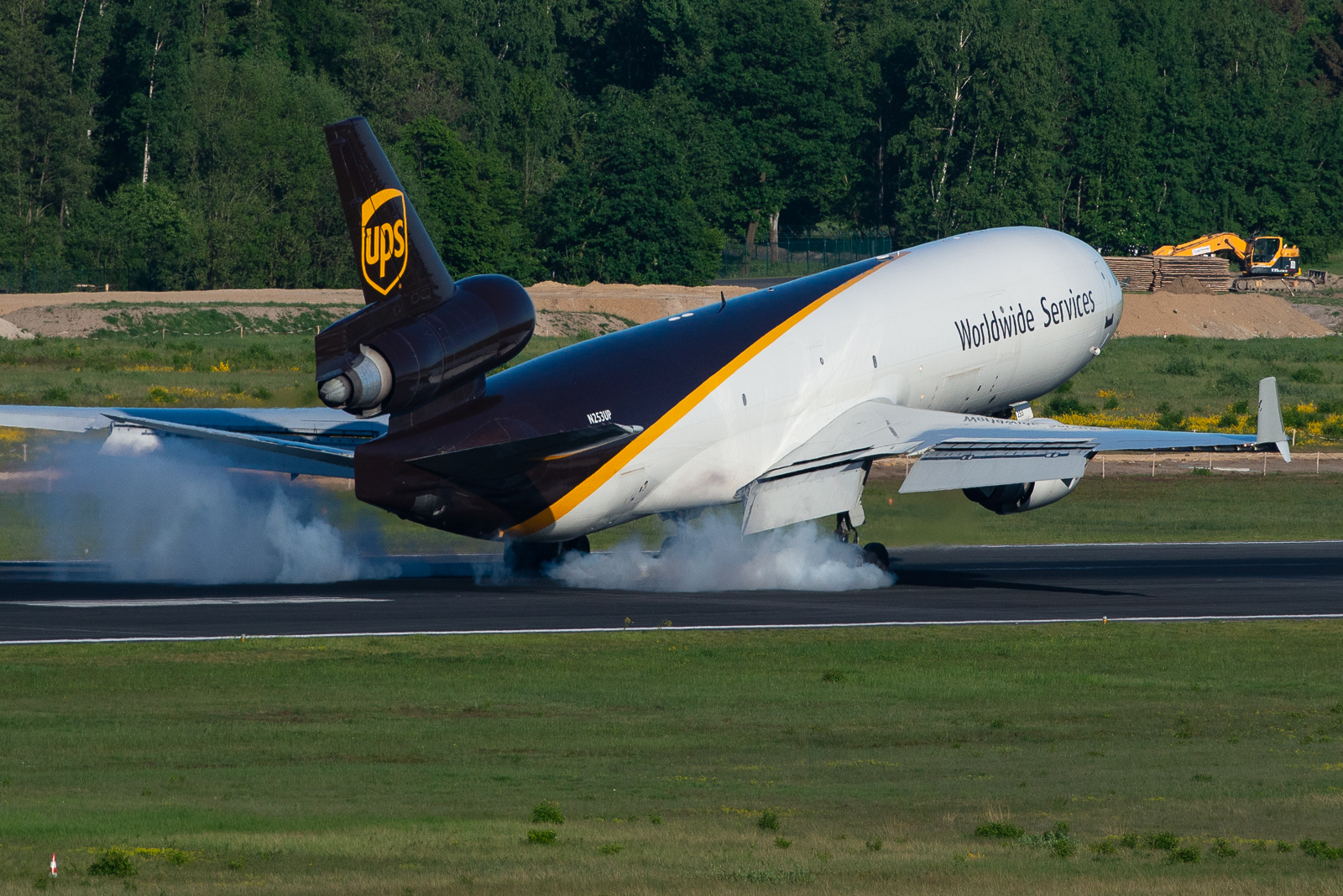
FAA Grounds All MD-11 Aircraft for Immediate Safety Inspections
By Arrival Guide News Desk | November 10, 2025
The U.S. Federal Aviation Administration (FAA) has issued an emergency order grounding all McDonnell Douglas MD-11 aircraft worldwide, following the fatal UPS crash in Louisville, Kentucky, on November 4. The move comes amid growing safety concerns after the aircraft’s left engine and pylon detached during takeoff — an incident that bears similarities to a 1979 crash involving an earlier McDonnell Douglas model.
The FAA’s emergency airworthiness directive, issued late on November 8, requires immediate inspection of all engine pylons before further flight. The agency said the grounding was necessary “to ensure continued safety” while investigators determine what caused the catastrophic structural failure.
UPS Flight 2976, a cargo service to Dallas/Fort Worth, lost its left-hand engine seconds before liftoff. Video footage shows flames trailing from the wing as the tri-jet struggled to gain altitude before crashing into an industrial area beyond the runway. All three pilots and 11 people on the ground were killed.
While the cause remains under investigation, the National Transportation Safety Board (NTSB) confirmed that the pylon separation closely resembles an earlier design failure that caused the deadly crash of American Airlines Flight 191 in Chicago in 1979. That DC-10, also built by McDonnell Douglas, lost its engine and pylon during takeoff due to structural damage sustained during maintenance — an accident that led to major design reviews across the DC-10 fleet.
Investigators are now exploring whether a similar mechanical or fatigue-related weakness could exist in the MD-11, the DC-10’s direct successor. The global MD-11 fleet is powered by either General Electric CF6-80C2 or Pratt & Whitney PW4000 engines, both mounted on pylons connected to the wing in a comparable configuration to the earlier model.
Boeing, which inherited the MD-11 program after its 1997 merger with McDonnell Douglas, had already recommended that all operators temporarily suspend MD-11 operations “out of an abundance of caution.” The FAA’s directive formalizes this suspension, grounding roughly 59 active aircraft worldwide. FedEx, UPS, and Western Global Airlines operate the remaining freighter fleet.
The NTSB has begun extensive structural testing, including computer simulations, to determine whether metal fatigue, vibration, or design stress contributed to the failure. Boeing engineers are assisting in the analysis and have pledged full cooperation with authorities.
The MD-11 has served as a reliable cargo workhorse for decades, but this grounding marks one of the most significant safety interventions in the aircraft’s history. Until investigators confirm that the issue has been fully resolved, all MD-11 flights will remain suspended.
Both Boeing and the FAA reaffirmed that the aircraft will only return to service once it is proven safe. The aviation community, meanwhile, is watching closely — aware that the echoes of 1979 still serve as a stark reminder of how critical pylon integrity is to flight safety.

